
Between Peace and Escape
And the quiet ways we come back to ourselves.

How comfortable are you with yourself? I mean truly comfortable — the kind where you can sit still without reaching for your phone or a distraction. Just you and your thoughts, no background music, no scrolls, no screens. Can you do that? Can you sit in silence long enough to notice your breathing, to watch thoughts arrive and leave, without judging them?
I’ve tried. I’ve failed.
Most of the time, my thoughts don’t sit quietly; they walk around, pace, argue, and replay things that don’t even matter anymore. Maybe that’s why we’ve created these ways of controlling our mind — meditation apps, spiritual influencers, morning routines. All teaching us how to make peace with what’s already inside. But can you really tame your mind? Can you reach that mythical point where thoughts float by without disturbing you?
I can’t. And I’ve stopped pretending I can.
For as long as I can remember, I’ve looked for ways to run away from my thoughts or at least make them quiet for a while.
Maybe that habit began years ago, on the third day of my MBA course, when I tore a ligament in my knee. I remember the sound more than the pain. That sharp crack that makes your heart sink even before your body reacts. I limped for weeks, and even when I walked again, something inside me stayed hesitant.
I’d dreamt of feeling free after years of preparation and pressure of getting to a secure life. Now when I was about to start one, my freedom came with a limp.
For a long time, that injury was just a physical inconvenience. But with time, I realized it had quietly rewritten how I dealt with my mind. You don’t notice how much you depend on your body to escape your head, until it stops cooperating.
After college, life moved fast. A corporate job, snacks after office hours, long meetings, little movement. The stress grew quietly, like background noise. I decided to start running in 2020. The kind of decision that feels heroic when you make it and foolish when you start doing it. The first few runs were disasters. Every step felt like I was dragging a mountain, but after weeks of persistence, I could run 5 kilometers in 35 minutes. Ordinary by most standards, but those runs made me feel like I had reclaimed a part of myself. For 35 minutes, I wasn’t thinking. I wasn’t worrying. I was free.
All was good until the pain came back. The ligament hadn’t forgotten me.
The physio didn’t sugarcoat it: no running, no sitting cross legged, no stairs, no jumping, no weight on one leg. It felt like being told to stop living the way someone normally would. I didn’t just lose movement; I lost a ritual that made my mind quiet.
But there’s always a way out. So I bought a bicycle and started cycling. A physio-approved exercise.
And I cycled like a man possessed. I saw my city unfold at a human pace — one pedal, one turn, one breath at a time. Once my body adjusted, I could cover 35+ kilometers in one ride. I could ride for more than an hour. I would come home drenched in sweat but oddly peaceful. My thoughts moved slower on a cycle; maybe because the world around me did too.

Above is the reel I made when I completed riding my bicycle for 1,000kms in 16 months.
Still, I wanted more.
November, in northern India, has its own personality. The air feels like a patient parent — kind, but firm. Mornings are cooler with a bite, afternoons soften, evenings smell of burning leaves and distant kitchens. That’s the month I used to take out my brother’s bike for early rides.
People talk about slow mornings with aesthetic photos, a cup of coffee and a book in hand. For me slow mornings meant reaching for the bike early in the morning, cleaning and wiping off the dew using a cloth. Opening the main door and taking the bike out. Quietly latch the door back. Sit on the bike, disable the engine kill switch, press the clutch lever and turn the ignition on. And she would come to life exactly how you wake up — reluctant and still trying to steal a few more minutes of sleep before you actually wake up. In a few seconds she would come alive. But you don’t ride immediately. You wait till she has settled and is breathing at a comfortable pace of around a thousand RPM, and then we’d go.
Once she started moving, the mind stopped. The road, the hum of the engine, the rhythm of the wind — that was all that existed. On highways, when we found our ideal speed, I felt nothing and everything at once. That was my version of meditation. People called it peace; I called it running away.
Most rides ended at the Garhmukteshwar ghat. I’d sip hot kulhad chai, the steam kissing my face while the cold wind brushed past. Watching the Ganga flow felt like watching my thoughts — continuous, unstoppable, indifferent. Peace or escape? At that point, they felt like the same thing.

Above, photos from one such ride.
Then life happened. I changed cities, got married, got busy. Told myself I’d outgrown the need for these escapes. But I hadn’t. I’d only replaced them.
Last year, I found myself stuck again. Thoughts looping endlessly, no exit in sight. I had my bicycle, my car, my loving wife, a decent life. But I was restless. So I did what I’ve always done: I drove. No destination, no plan, just roads. I explored every ghat around Pune. The car was happy; I convinced myself I was too.
Don’t get me wrong, I have a great support system. Solid people. But if you don’t know how to accept help, even the best support system feels like background noise. It’s like choosing junk food when someone is offering you something nourishing. You know better, but you still don’t stop.
Maybe escaping is just my default. Taking an exit feels familiar, like muscle memory. To most people, I look grounded, consistent, the person they can rely on. But beneath that steadiness is someone who’s always looking for a way out when things get too heavy.
Now, here I am, in Ahmedabad.
People say you need fancy things to feel at peace — a superbike, expensive running shoes or cafe hopping. I don’t think so. You just need a reason to escape, and you’ll find one.
That’s how I ended up taking out my brother’s Honda Activa. Reliable, steady, unpretentious. She doesn’t roar or show off; she just gives you the space to breathe and be.
I rode to a cafe to unwind, hoping to feel like an author with my laptop open, coffee cup perfectly placed, and notepad filled with deep thoughts. None of that happened.
What I did notice was a father with his little girl, maybe two years old, her hair tied in two ponytails, laughing in his arms. She reminded me of my daughter — just two months old, miles away, sleeping peacefully at her grandparents’ house. I imagined the day I’d take her to a cafe like this. We’d talk about different coffees, and I’d tell her that sipping an expensive coffee gives you a kind of peace. So does drinking ten-rupee chai at a roadside stall. Both matter, because both are different kinds of quiet.
I just hope I don’t build expectations so heavy that she ever feels like she has to run away from me. That would hurt the most.
After finishing my coffee, I rode without purpose. I saw IIM Ahmedabad on the way — the college I badly wanted to get into back when I was preparing for MBA. I saw idiots on road because Amdavadis don’t respect traffic rules. I saw traffic jams and while I was absorbing everything Ahmedabad has to offer, I saw the quiet riverfront. The one which isn’t screaming for attention at 4:30 PM on a Saturday. I find my way to it, park the scooter and order coffee. The one which appeals to your middle class mind, not the version of you who was at a cafe few minutes back.
Sabarmati was flowing unbothered. A Muslim family nearby was bursting those small crackers you throw at the ground. The father was helping his daughter, and the mother was recording it all on her phone. Maybe one day they’ll rewatch those moments when life gets hard and this will be their own little way of escaping.
I sat there with the coffee, sketching on my notebook. Some people stared, others didn’t notice. My thoughts behaved the same way. Some lingered, some drifted. When one stayed longer than it should’ve, I sipped the coffee and let it pass.
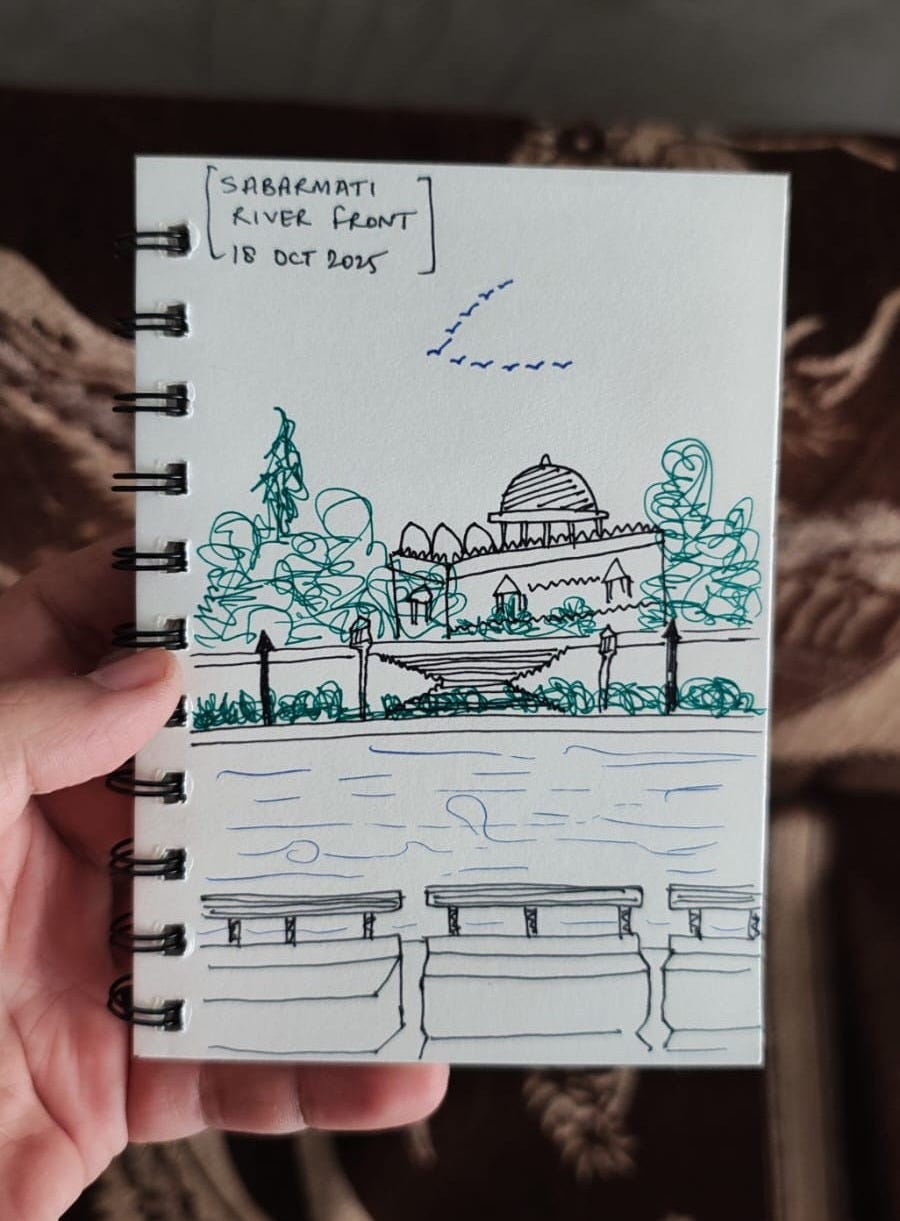
And in that quiet, I escaped again.
Because that’s what I do. I escape from expectations, from time, from versions of myself that others built. Maybe from the noise of life itself. I don’t know if that’s wrong. I just know I’m learning to see the difference between running away and finding stillness.
Maybe that’s all acceptance really is? Learning when to stop fighting your mind and when to quietly walk away from it.
I’m still figuring it out. I probably will be for a long time. Until then, you’ll find me somewhere on a quiet road, on a cycle, or in a cafe escaping a little, breathing a little, living just enough to write the next story.
So tell me, do you escape too?
P.S. If the part about the Muslim family made you think about unity in diversity and all that, relax. They were just a family having a good time. Nothing more, nothing less.
👌🏻If you enjoyed reading this piece, nothing says I really loved your writing than liking, sharing, restacking, commenting and subscribing to my Substack.😄
You can also buy me a coffee to support my writing.
See you soon with more fun content😁
This was really such a lovely read! Loved it 🥹
I get the running part and the bike part. I pinched a nerve while playing football once ( which was my escape at that time) and it hurts from time to time still. Cycling is my aid now. Escaping the thoughts is really what has become a survival mechanism for me too.. sometimes the 'running away' ritual works, sometimes it doesn't, and when it doesn't then it fuels other impulses and the cycle doesn't end. It really has to stop someday soon, but till then I don't know what else could be done.
This was really beautifully written. That college part was also really so truee🥹
I hope you're doing well!
And the sketch was really lovely too, in the way it reflected rawness and honesty to the moment.
Just beautiful, 🤌🏻✨
I've spent years trying to teach people to sit still, and here you are admitting that movement is how you find stillness. That's honest in ways most meditation teachers aren't. Your hope about your daughter never having to escape from you? That's the heart of this whole piece. Beautifully written, Abhishek.